Time features a fascinating collection of 11 photos, entitled "The Dangers of Printing Money," that help chronicle what life was like during the hyperinflation of the Weimar era.
Tough Times In the years following World War I, Germany took to printing money to help meet expenses. With inflation spiraling and the mark plummeting, things worsened when the French occupied Germany's industrial Ruhr region. Workers, the middle class and pensioners were hit hardest by the crisis. Here, the Salvation Army serves hungry Berliners in the dark days of 1923.
Child's Play Forget toys: with as many as 4.2 trillion marks to the dollar by late 1923, German children played in the streets with worthless money.
Walking a Tightrope With the mark almost worthless, bartering made a comeback. Germans are seen here swapping bread, sausages and jam for tickets to the circus.
Black Market With dollars a prized possession, two men trade marks for U.S. currency on a street in Berlin in 1922. [Editor's note: I'm wondering if the trade might go in the opposite direction next time around.]
Who Wants To Be A Millionaire?
Amid runaway inflation, new bank notes were issued. This, a 50 million mark bill from 1923, was small change compared to the 100 trillion mark notes that were also being printed.
Marked Men
Millions of marks are stacked and counted in a Cologne bank, ready for distribution to stricken customers.
Money For Nothing
The collapse of the mark made it cheaper to paper a wall with bank notes than to buy wallpaper.
Bag it Up
Rocketing inflation in 1922 meant this grocer's cash register had to be emptied regularly, and its contents stored in a tea chest. Workers were known to collect their wages in suitcases, before spending them immediately.
Fanning the Flames
German marks might not have bought much back in 1923, but they were useful for lighting the stove.
Sign of the Times
At this Berlin food store, meat and fish fetched exorbitant prices. Pickled herrings — at 350 marks each — are the cheapest on offer. The mark would eventually recover and was the Federal Republic of Germany's official currency until it was replaced by the euro.
time
Visualizzazione post con etichetta fotografia. Mostra tutti i post
Visualizzazione post con etichetta fotografia. Mostra tutti i post
martedì 25 giugno 2013


lunedì 26 novembre 2012
“LA CRISI E LA VERGOGNA”
MOSTRA FOTOGRAFICA DI BRUNO OLIVIERO
A CURA DI
BARBARA LUGARA’E GIANLUCA MARZIANI
CON SIMONETTA LEIN.
“LA CRISI E LA VERGOGNA”

APRIRA’ AL PUBBLICO
Oggi 26 NOVEMBRE
ALLE 18.3O
PRESSO
IL CASTELLO D’ARAGONA-CITTA’DI TARANTO
Una mostra però dove la parola “crisi” non ha solo una valenza economica, bensì un’accezione molto più profonda dal punto di vista identitario: la vera crisi è quella dell’individuo che, privato dei propri diritti e della dignità, non riesce più a percepirsi come tale e viene assalito da un forte senso di vergogna.
La BLUGARA, società di management e comunicazione , ha scelto Taranto non casualmente:
Taranto infatti, meglio di ogni altra città rischia di diventare un palcoscenico fondamentale per la comprensione del momento politico sociale che stiamo vivendo.
8OOO dipendenti dell’ILVA azienda leader nel settore delle acciaierie rischiano di rimanere senza lavoro.
Moltissime persone, uomini e donne, famiglie con bambini potrebbero trovarsi in serissime condizioni di disagio economico.
Si e’ dunque pensato che proprio Taranto potesse ospitare una mostra con un fortissimo contenuto sociale.

La mostra si propone di cogliere questo momento di crisi economica, sociale e culturale da una prospettiva particolare, insolita se si vuole, monitorando cioè le reazioni e la capacità di adattamento della donna a ciò che le accade intorno.
Lo scopo è quello di ritrarre un fenomeno sociale ormai noto, di lasciare traccia indelebile di questi anni, usando come cartina al tornasole la società femminile che si trasforma e reagisce ai problemi più comuni in un quotidiano sempre più complesso.
Le fotografie mostrano gli effetti più devastanti della crisi economica: dal prezzo della benzina salito alle stelle alle spese quotidiane che aumentano a dismisura, dallo sfaldamento dei valori alla difficoltà di divenire madre, dalla precarietà all’impossibilità di mantenere i propri figli, dal disagio sociale fino al crollo delle certezze.
Il tentativo è quello di invitare il fruitore ad entrare nell’opera, cercando di portarlo – attraverso il medium della fotografia – alla comprensione, all’immedesimazione e alla vicinanza allo stato d’animo del personaggio.
La Mostra infatti, nasce non solo per catalizzare l’attenzione dei media ma anche per dare un vero contributo economico, nel caso di Taranto sosterrà con parte degli incassi la ABFO associazione volontaria onlus nata proprio a Taranto nel 2OO5 che ha l’intento di prendersi cura di quanti soprattutto famiglie e bambini vivono situazioni disagiate.
L’ARTE DUNQUE NON SOLO PER COMPIACIMENTO DEI SENSI MA ANCHE PER SENSIBILIZZARE GLI ANIMI.
Fonte
RIFLESSIONE È LA PAROLA CHIAVE
Se è vero, come diceva Theodor Adorno, che: “le forme dell’arte registrano la storia degli uomini con più esattezza dei documenti”, le fotografie possono essere considerate una delle tante forme d’arte che rispecchiano la realtà. Un modo altro, diverso, per riflettere sulla crisi e sulla capacità di ognuno di rapportarsi alla difficile situazione che stiamo vivendo.Bruno Oliviero è rinomato per essere il fotografo delle Star, colui che per più di 40 anni è riuscito a ritrarre il meglio di personaggi che hanno fatto la storia dei nostri tempi: da Sophia Loren a Catherine Deneuve, da Giorgio Armani a Alberto Sordi. Giunto ad una fase matura della sua attvità, Oliviero abbandona i personaggi famosi per dedicarsi al sociale, impegnandosi in questa che sarà una delle mostre a maggiore impatto visivo degli ultimi tempi. Un repertorio fotografico in cui tutti potranno riconoscersi poiché affronta i problemi più drammatici e urgenti della società odierna. Il progetto è studiato per avere un grande impatto mediatico e rappresentare un vero e proprio evento sociale. La mostra sarà inaugurata a Taranto e resa successivamente itinerante.
LA CRISI NEL VISSUTO QUOTIDIANO
La sapiente lente fotografica di Bruno Oliviero si propone di cogliere questo momento di crisi economica, sociale e culturale da una prospettiva particolare, insolita se si vuole, monitorando cioè le reazioni e la capacità di adattamento della donna a ciò che le accade intorno. Lo scopo è quello di ritrarre un fenomeno sociale ormai noto, di lasciare traccia indelebile di questi anni, usando come cartina al tornasole la società femminile che si trasforma e reagisce ai problemi più comuni in un quotidiano sempre più complesso.Le fotografie mostrano gli effetti più devastanti della crisi economica: dal prezzo della benzina salito alle stelle alle spese quotidiane che aumentano a dismisura, dallo sfaldamento dei valori alla difficoltà di divenire madre, dalla precarietà all’impossibilità di mantenere i propri figli, dal disagio sociale fino al crollo delle certezze.
Il tentativo è quello di invitare il fruitore ad entrare nell’opera, cercando di portarlo - attraverso il medium della fotografia - alla comprensione, all’immedesimazione e alla vicinanza allo stato d’animo del personaggio.
La mostra, inoltre, ha anche l’obiettivo di fare beneficienza, offrendo un concreto contributo alle iniziative della ABFO: associazione volontaria onlus, nata proprio a Taranto nel 2005 con l’intento di prendersi cura di quanti, soprattutto famiglie e bambini, vivono situazioni disagiate.
ARTISTI
Bruno Oliviero - Il fotografoDopo i grandi successi delle due ultime pubblicazioni, - Dive & Divi. Virtù e vizi (2012) e Le Peccatrici (1993) - il grande fotografo Bruno Oliviero ripensa la sua attività e, in una fase matura della sua carriera decide di mettere la sua abilità al servizio del sociale, trasformandosi in attento osservatore della realtà, prima come regista di un cortometraggio e ora con una mostra fotografica di grande attualità. Scatti a colori e in bianco e nero per esprimere la profondità e la forza del cambiamento che la nostra società sta affrontando.
Simonetta Lein - Protagonista dello shooting
Protagonista dello shooting: Simonetta Lein, scrittrice e attrice, che ha prestato il suo volto per rappresentare la donna che si trasforma e ripensa la sua vita adeguandosi ai tempi della crisi.
E con la partecipazione di Davide Reali.
CASTELLO ARAGONESE DI TARANTO
26 - 30 NOVEMBRE 2012
Galleria Comunale Castello Aragonese Di Taranto, Piazza Castello 4, 74100 Taranto
mercoledì 30 novembre 2011
DADAAB
In questo periodo non si parla d’altro che della crisi economica e finanziaria che colpisce la zona euro e in particolare i paesi europei più deboli, Italia compresa.
Abituati, come eravamo, ad abitare nel “Paese di Bengodi”, ora ci risulta molto difficile rinunciare a tutto il superfluo di cui sentivamo la assoluta necessità, per non dire il diritto di possedere. Certamente i sacrifici, che dovremo affrontare, cadranno, come sempre, sulle spalle dei più deboli.
E, come sempre, i più deboli sono i lavoratori, i precari, i disoccupati, i giovani e gli anziani con la minima di pensione. Per fare fronte ai nostri impegni debitori, bisognerebbe andare a pescare nelle tasche di chi detiene ricchezza, ma è sempre risultato difficile che chi detiene il denaro e quindi il potere possa togliersi di tasca ciò che crede essere il guadagno del suo tanto operoso ingegno. La cosa strana, nella nostra società, è sempre stata che chi lavora duramente non ha niente, se non il minimo per vivere e poter continuare a lavorare per chi gode di privilegi (le varie caste, politica, commis di stato, squali della finanza e dell’imprenditoria), tanto che quest’ultimi si possono permettere tutto a scapito di tanti.
“La Banca d’Italia dice che nel 2009 tutte le famiglie possedevano più o meno 350 mila euro in beni di vario tipo. E’ la vecchia storia dei morti sulle autostrade. Se ogni anno ci sono mille viaggiatori e cinquecento morti, significa che siamo tutti mezzi morti.
Invece la vita insegna che c’è chi muore e chi se la spassa. Nella fattispecie, delle 24.905.042 famiglie italiane [al 31 dicembre 2009, fonte Istat], ce ne sono 2 milioni, 490 mila e 504 (10%) che se la spassano, possedendo oltre il 45% dei 9 miliardi e mezzo di euro cui assomma la ricchezza lorda di tutte le famiglie messe insieme, e oltre 12 milioni (12.452.521) che se la vedono male, dovendo spartirsi un misero 10%.
In parole povere, col cavolo che la ricchezza di ogni famiglia assomma a 350 mila euro: ci sono 10 famiglie su 100 che hanno in media un milione e mezzo di euroa testa e 50 famiglie su 100 che non arrivano a 70 mila. Di più, queste ultime hanno un reddito medio familiare annuo di 8.019,30€ contro i quasi 200 mila euro delle 10 famiglie vip.
Tanto per schiarirvi le idee, se la torta intera fosse la ricchezza disponibile, e ogni smiley fossero 2 milioni e mezzo di famiglie, la situazione del nostro paese a tutto il 2009 sarebbe più o meno questa.
![clip_image001[5]](https://blogger.googleusercontent.com/img/b/R29vZ2xl/AVvXsEgw4LVH8EFe-X3DEdEVipIAPDmGb3QVqIlf8I98rBKtR6ogpLAdMDbqrMukgQEdFoCZvOnDRVsd298YqBzn97_KTh6wdQreBPyd-tDDQPcohwjtNuancxbrvT4Nz1qv0wSQUN3jxalqap8f/?imgmax=800 "clip_image001[5]")
10 famiglie su 100 hanno uno spazio vitale degno di un imperatore, 40 si accontentano di un modesto giardinetto privato (sono quelle che fanno la settimana bianca) e 50 vivono accatastate le une sulle altre come e peggio delle galline in un moderno allevamento di polli, dove la luce del sole è un miraggio e se vai di corpo fai lo shampoo a quello di sotto. La storia tristemente insegna che prima o poi le 50 faccine rosse, livide di rabbia, invadono i giardini fioriti delle 10 faccine sorridenti, che smettono di sorridere.
Buon senso vorrebbe invece che, sulla torta, ciascuno avesse più o meno lo stesso spazio, ma ciò che alcuni chiamano ragionevole, altri lo chiamano comunismo. Punti di vista. Intendiamoci: una distribuzione di risorse e di ricchezze perfettamente equa è utopica e forse contraria alla natura competitiva dell’essere umano, ma anche un sistema sociale nel quale il divario in termini di benessere sia tanto esasperato da suonare offensivo è insostenibile.” segue
Ora, in base a queste argomentazioni proporrei di offrire una speciale vacanza a quel 10% delle famiglie italiane che possiedono oltre il 45% della ricchezza complessiva. Sarebbe, senza ombra di dubbio, una vacanza istruttiva e diversa dalle abituali ed usuali a cui sono abituate. La vacanza premio avrebbe la durata di 10 anni e la location (termine molto di moda oggi) è, niente popò di meno che
Una fotografia aerea del campo profughi di Dadaab, in Kenya, uno dei più affollati al mondo, postata su Flickr da Oxfam International, mostra quanto il problema degli sfollati possa essere grave. Nel campo vivono 450.000 rifugiati, la maggioranza dei quali fuggiti dalla siccità e dalla guerra civile scoppiata in Somalia nel 1991. Altri 1.500 profughi arrivano ogni giorno.
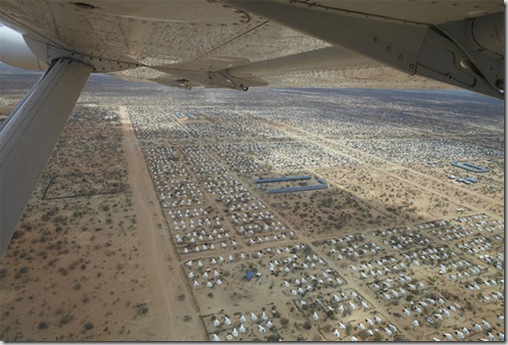
Nella speranza di trovare tregua dal conflitto, dalla carestia e dai disastri naturali, si stima che il 75% di tutti i rifugiati vivano in Paesi confinanti con il proprio, dando vita a una crisi umanitaria che sfrutta al massimo le risorse dei governi ospitanti e delle organizzazioni internazionali. Fonte
KATE HOLT, una fotogiornalista freelance ci mostra la realtà quotidiana di questa gente che vive in terribili condizioni da vent’anni. Questa gente sa che cosa è la crisi. Per questo la dovrebbe conoscere anche quel citato 10% di famiglie italiane.

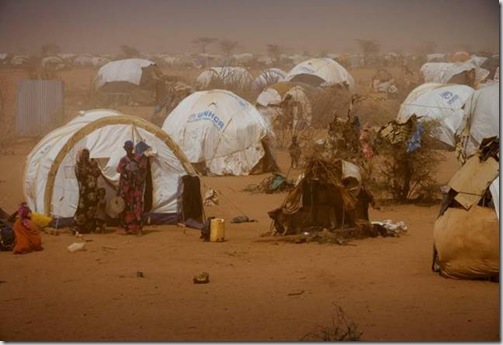

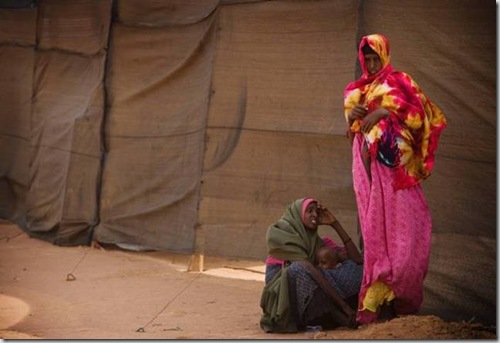


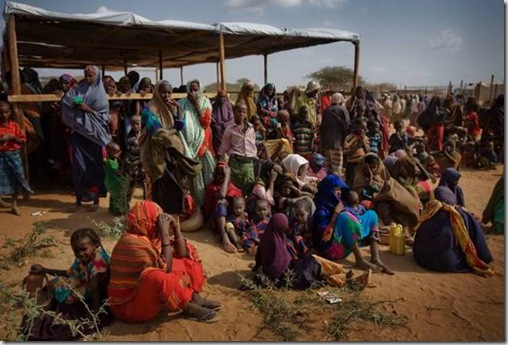


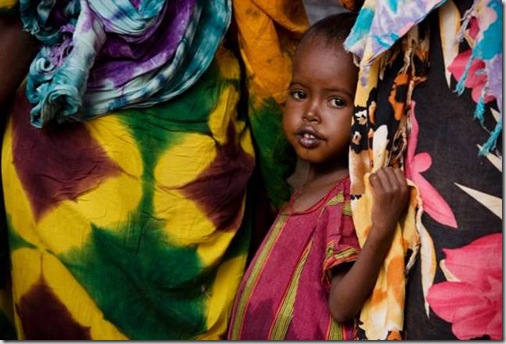
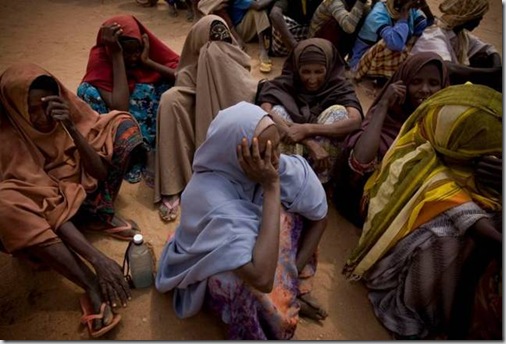


Mia Farrow, UNICEF Goodwill Ambassador, meets severely malnourished children on a one day visit to Dadaab Refugee Camp, in Dadaab, Northeastern Kenya on the 26th August, 2011. Mia Farrow is on a visit with UNICEF to Kenya to highlight the ongoing nutrition crisis affecting the Horn of Africa.
website: www.kateholt.com/
Explore the conditions in Dadaab further using Google Maps and Images.
KATE HOLT
Born in Zimbabwe, I traveled extensively with my family while young, but my first trip alone was to Romania, following the fall of Ceausescu in 1991.
News of the horrific conditions in which Romania's unwanted children were being kept had hit the British headlines and I decided to see what I could do to help. I arrived at Negru Voda orphanage in January 1992 after leaving school. It was home to 360 severely disabled children. Many had never left the confines of their wards where they were crammed three to a bed - beating their heads against the walls in violent frustration, or rocking silently to comfort themselves after years of neglect. Romania's forgotten children had a huge effect on me. At the age of 19 I had no idea the world could be so cruel. I worked there for a year and returned every summer while studying at university.
Realizing that aid work touched the tip of much bigger issues, I turned to journalism as a way to expose these to a wider audience, and those with power to make a difference. After leaving St Andrew's University, I joined the BBC's News and Current Affairs department and subsequently went on to study photojournalism at the London College of Printing.
Traveling to Bosnia in the wake of the war I continued on to Albania to document the refugees who flooded over the border from Kosova in 1999. The post conflict environment of the Balkans fascinated me and I became aware that the most vulnerable people, primarily women and children, were slipping through the net of international aid, which opened them up to exploitation and abuse. Returning to Bosnia, I spent a year uncovering the exploding sex slave trade - young girls trafficked from Romania, Moldova and the Ukraine being bought and sold as commodities, primarily to service the sexual needs of the International Community. This was the first time the issue of women being trafficked from Eastern Europe for sexual use had been exposed.
Moving on to work in DR Congo in 2003 I uncovered extensive sexual abuse of young girls by UN peace keepers, as well as high level cover ups of the issue by UN personnel in New York. The findings of this story forced Kofi Annan, then Secretary General of the United Nations, to announce a "zero tolerance" policy within the UN to sexual exploitation.
Backed by The Independent Newspaper, I continued to investigate the issue, which eventually led to the forced resignation of the head of the UNHCR, Rudd Lubbers.
Nominated three times for the Amnesty Award for Humanitarian reporting, as well as the Prix Pictet Photographic Award, I have worked extensively in East and Southern Africa for the last ten years, and more recently have returned to working in both Afghanistan and Somalia.
Tornando a noi, quanto tempo passerà, prima che i 31 milioni di italiani ammassati nella fetta rossa della torta decidano che è venuto il momento di dare una risistematina alla spartizione del benessere?
Abituati, come eravamo, ad abitare nel “Paese di Bengodi”, ora ci risulta molto difficile rinunciare a tutto il superfluo di cui sentivamo la assoluta necessità, per non dire il diritto di possedere. Certamente i sacrifici, che dovremo affrontare, cadranno, come sempre, sulle spalle dei più deboli.
E, come sempre, i più deboli sono i lavoratori, i precari, i disoccupati, i giovani e gli anziani con la minima di pensione. Per fare fronte ai nostri impegni debitori, bisognerebbe andare a pescare nelle tasche di chi detiene ricchezza, ma è sempre risultato difficile che chi detiene il denaro e quindi il potere possa togliersi di tasca ciò che crede essere il guadagno del suo tanto operoso ingegno. La cosa strana, nella nostra società, è sempre stata che chi lavora duramente non ha niente, se non il minimo per vivere e poter continuare a lavorare per chi gode di privilegi (le varie caste, politica, commis di stato, squali della finanza e dell’imprenditoria), tanto che quest’ultimi si possono permettere tutto a scapito di tanti.
“La Banca d’Italia dice che nel 2009 tutte le famiglie possedevano più o meno 350 mila euro in beni di vario tipo. E’ la vecchia storia dei morti sulle autostrade. Se ogni anno ci sono mille viaggiatori e cinquecento morti, significa che siamo tutti mezzi morti.
Invece la vita insegna che c’è chi muore e chi se la spassa. Nella fattispecie, delle 24.905.042 famiglie italiane [al 31 dicembre 2009, fonte Istat], ce ne sono 2 milioni, 490 mila e 504 (10%) che se la spassano, possedendo oltre il 45% dei 9 miliardi e mezzo di euro cui assomma la ricchezza lorda di tutte le famiglie messe insieme, e oltre 12 milioni (12.452.521) che se la vedono male, dovendo spartirsi un misero 10%.
In parole povere, col cavolo che la ricchezza di ogni famiglia assomma a 350 mila euro: ci sono 10 famiglie su 100 che hanno in media un milione e mezzo di euroa testa e 50 famiglie su 100 che non arrivano a 70 mila. Di più, queste ultime hanno un reddito medio familiare annuo di 8.019,30€ contro i quasi 200 mila euro delle 10 famiglie vip.
Tanto per schiarirvi le idee, se la torta intera fosse la ricchezza disponibile, e ogni smiley fossero 2 milioni e mezzo di famiglie, la situazione del nostro paese a tutto il 2009 sarebbe più o meno questa.
![clip_image001[5]](https://blogger.googleusercontent.com/img/b/R29vZ2xl/AVvXsEjMJf59cjlGFULqM9vCqQogkVCWVbU35AV9SwCvEyAsGK-KozgQhwFkTltotSDH1oC3qr1kepe9PUQSl7p_-IK4KEkdsYRQBcF4Q0CrwCFkM6j8-0ELkQxRUSXa7b5luWhPpQbpEl77bqVs/s1600-h/clip_image001%25255B5%25255D%25255B5%25255D.jpg "clip_image001[5]")
10 famiglie su 100 hanno uno spazio vitale degno di un imperatore, 40 si accontentano di un modesto giardinetto privato (sono quelle che fanno la settimana bianca) e 50 vivono accatastate le une sulle altre come e peggio delle galline in un moderno allevamento di polli, dove la luce del sole è un miraggio e se vai di corpo fai lo shampoo a quello di sotto. La storia tristemente insegna che prima o poi le 50 faccine rosse, livide di rabbia, invadono i giardini fioriti delle 10 faccine sorridenti, che smettono di sorridere.
Buon senso vorrebbe invece che, sulla torta, ciascuno avesse più o meno lo stesso spazio, ma ciò che alcuni chiamano ragionevole, altri lo chiamano comunismo. Punti di vista. Intendiamoci: una distribuzione di risorse e di ricchezze perfettamente equa è utopica e forse contraria alla natura competitiva dell’essere umano, ma anche un sistema sociale nel quale il divario in termini di benessere sia tanto esasperato da suonare offensivo è insostenibile.” segue
Ora, in base a queste argomentazioni proporrei di offrire una speciale vacanza a quel 10% delle famiglie italiane che possiedono oltre il 45% della ricchezza complessiva. Sarebbe, senza ombra di dubbio, una vacanza istruttiva e diversa dalle abituali ed usuali a cui sono abituate. La vacanza premio avrebbe la durata di 10 anni e la location (termine molto di moda oggi) è, niente popò di meno che
DADAAB
meta turistica dove apprendere quanto sia inumano e criminale trattare gli altri come esseri inferiori, solo perchè poveri e poveri, perchè defraudati delle loro proprietà e dei loro diritti.
Ed ecco a voi DADAAB
IL CAMPO PROFUGHI PIÙ AFFOLLATO DEL MONDO

Vista aerea di Dadaab, il campo profughi più affollato al mondo © Oxfam International
Nella speranza di trovare tregua dal conflitto, dalla carestia e dai disastri naturali, si stima che il 75% di tutti i rifugiati vivano in Paesi confinanti con il proprio, dando vita a una crisi umanitaria che sfrutta al massimo le risorse dei governi ospitanti e delle organizzazioni internazionali. Fonte
KATE HOLT, una fotogiornalista freelance ci mostra la realtà quotidiana di questa gente che vive in terribili condizioni da vent’anni. Questa gente sa che cosa è la crisi. Per questo la dovrebbe conoscere anche quel citato 10% di famiglie italiane.


all images © Kate Holt all rights reserved

Mia Farrow, UNICEF Goodwill Ambassador, meets severely malnourished children on a one day visit to Dadaab Refugee Camp, in Dadaab, Northeastern Kenya on the 26th August, 2011. Mia Farrow is on a visit with UNICEF to Kenya to highlight the ongoing nutrition crisis affecting the Horn of Africa.
website: www.kateholt.com/
Explore the conditions in Dadaab further using Google Maps and Images.
KATE HOLT
Born in Zimbabwe, I traveled extensively with my family while young, but my first trip alone was to Romania, following the fall of Ceausescu in 1991.
News of the horrific conditions in which Romania's unwanted children were being kept had hit the British headlines and I decided to see what I could do to help. I arrived at Negru Voda orphanage in January 1992 after leaving school. It was home to 360 severely disabled children. Many had never left the confines of their wards where they were crammed three to a bed - beating their heads against the walls in violent frustration, or rocking silently to comfort themselves after years of neglect. Romania's forgotten children had a huge effect on me. At the age of 19 I had no idea the world could be so cruel. I worked there for a year and returned every summer while studying at university.
Realizing that aid work touched the tip of much bigger issues, I turned to journalism as a way to expose these to a wider audience, and those with power to make a difference. After leaving St Andrew's University, I joined the BBC's News and Current Affairs department and subsequently went on to study photojournalism at the London College of Printing.
Traveling to Bosnia in the wake of the war I continued on to Albania to document the refugees who flooded over the border from Kosova in 1999. The post conflict environment of the Balkans fascinated me and I became aware that the most vulnerable people, primarily women and children, were slipping through the net of international aid, which opened them up to exploitation and abuse. Returning to Bosnia, I spent a year uncovering the exploding sex slave trade - young girls trafficked from Romania, Moldova and the Ukraine being bought and sold as commodities, primarily to service the sexual needs of the International Community. This was the first time the issue of women being trafficked from Eastern Europe for sexual use had been exposed.
Moving on to work in DR Congo in 2003 I uncovered extensive sexual abuse of young girls by UN peace keepers, as well as high level cover ups of the issue by UN personnel in New York. The findings of this story forced Kofi Annan, then Secretary General of the United Nations, to announce a "zero tolerance" policy within the UN to sexual exploitation.
Backed by The Independent Newspaper, I continued to investigate the issue, which eventually led to the forced resignation of the head of the UNHCR, Rudd Lubbers.
Nominated three times for the Amnesty Award for Humanitarian reporting, as well as the Prix Pictet Photographic Award, I have worked extensively in East and Southern Africa for the last ten years, and more recently have returned to working in both Afghanistan and Somalia.
Tornando a noi, quanto tempo passerà, prima che i 31 milioni di italiani ammassati nella fetta rossa della torta decidano che è venuto il momento di dare una risistematina alla spartizione del benessere?
lunedì 18 luglio 2011
SICCITÀ IN EAST AFRICA
The worst drought in the Horn of Africa has sparked a severe food crisis and high malnutrition rates, with parts of Kenya and Somalia experiencing pre-famine conditions, the United Nations has said. More than 10 million people are now affected in drought-stricken areas of Djibouti, Ethiopia, Kenya, Somalia and Uganda and the situation is deteriorating.
Faduma Sakow Abdullahiand her five children tried to escape starvation in Somalia by journeying to a Kenyan refugee camp. Only one day before they reached their destination, her 4-year-old daughter and 5-year-old son died of exhaustion and hunger. At first the 29-year-old widow thought the two were merely sleeping when they wouldn’t get up after a brief rest. She had to leave their bodies under a tree, unburied, so she could push on with her baby, 2-year-old and 3-year-old. She saw more than 20 other children dead or unconscious abandoned on the roadside. Eventually a passing car rescued the rest of her family from what could have been death.
“I never thought I would live to see this horror,” she said, tears rolling down her cheeks as she described the 37-day trek to Dadaab, the world’s largest refugee camp.
Tens of thousands of Somalis have watched their land dry up after years without rain. Then the livestock died. Finally all the food ran out. Now they are making the perilous journey over parched earth to refugee camps in Kenya and Ethiopia, regions that also have been hit hard by drought.
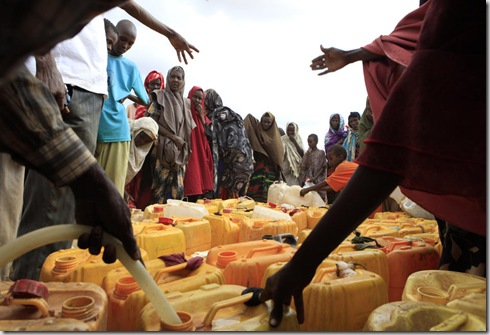
Recently-arrived Somali refugees wait to fill jerry cans with water at a newly-installed tank in Iffou 2, an area earmarked for refugee camp expansion, but yet to be approved by the Kenyan government, outside Dadaab, Kenya, Monday, July 11, 2011. U.N. refugee chief Antonio Guterres said Sunday that drought-ridden Somalia is the "worst humanitarian disaster" in the world, after meeting with refugees who endured unspeakable hardship to reach the world's largest refugee camp in Dadaab, Kenya. (AP Photo/Rebecca Blackwell)

Members of the family of Rage Mohamed are overtaken by wind-blown dust as they build a makeshift shelter around a thorny acacia tree, on the outskirts of Dagahaley Camp, outside Dadaab, Kenya, Sunday, July 10, 2011. It took the 15-person family five days to make the journey from their drought-stricken home in Somalia. They spent two nights sleeping in the open air under the tree prior to receiving tarps on Sunday. U.N. refugee chief Antonio Guterres said Sunday that drought-ridden Somalia is the "worst humanitarian disaster" in the world after meeting with refugees who endured unspeakable hardship to reach the world's largest refugee camp in Dadaab, Kenya. (AP Photo/Rebecca Blackwell)
 A young Somali girl who fled violence and drought in Somalia stands in line among adults outside a food distribution point in Dadaab refugee camp in northeastern Kenya on July 5, 2011. Dadaab, a complex of three settlements, is the world's largest refugee camp. Built to house 90,000 people and home to more than four times that number, it was already well over its maximum capacity before an influx of 30,000 refugees in the month of June. Upon arrival, the refugees find themselves tackling a chaotic system that sees new arrivals go days, even weeks, without food aid. "It still takes too much time for refugees to get proper assistance," Antoine Froidevaux, MSF's field coordinator in Dadaab told AFP. "The answer in terms of humanitarian aid is not satisfactory at all at the moment." ROBERTO SCHMIDT/AFP/Getty Images

A Somali woman waiting amongst scores of other refugees, all hoping to receive their ration cards despite a processing backlog, pleads with an organizer in Dagahaley Camp, outside Dadaab, Kenya, Monday, July 11, 2011. U.N. refugee chief Antonio Guterres said Sunday that drought-ridden Somalia is the "worst humanitarian disaster" in the world, after meeting with refugees who endured unspeakable hardship to reach the world's largest refugee camp in Dadaab, Kenya. (AP Photo/Rebecca Blackwell)

A Somali man who fled violence and drought in Somalia with his family sits on the ground outside a food distribution point in the Dadaab refugee camp. ROBERTO SCHMIDT/AFP/Getty Images
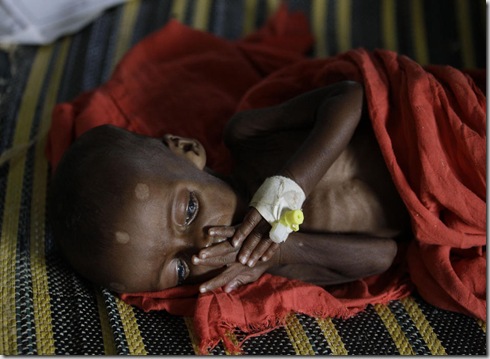 One-year-old, Habibo Bashir, rests on a bed at a Doctors Without Borders hospital where he is being treated for severe malnutrition, in Dagahaley Camp, outside Dadaab, Kenya, Monday, July 11, 2011. U.N. refugee chief Antonio Guterres said Sunday that drought-ridden Somalia is the "worst humanitarian disaster" in the world, after meeting with refugees who endured unspeakable hardship to reach the world's largest refugee camp in Dadaab, Kenya. (AP Photo/Rebecca Blackwell)

A refugee holds her child in her arms as she and others like her mass outside a food distribution point in Dadaab in the hope of getting access to much needed aid at the worlds biggest refugee camp in the world on July 4, 2011. With a population of 370,000, Dadaab is the world's largest refugee camp even though it was built for just 90,000. With serious drought in the Horn of Africa, thousands of Somalis have arrived in recent weeks in search of food and water. AFP PHOTO/Roberto SCHMIDT

A Somali refugee drags a sack with food aid given to her at a food distribution point at the Dadaab refugee camp. ROBERTO SCHMIDT/AFP/Getty Images

Refugees newly arrived from Somalia line up to receive food rations at a receiving center in Dagahaley Camp, outside Dadaab, Kenya. The United Nations High Commissioner for Refugees estimates 1300 new refugees fleeing drought and hunger in Somalia are arriving daily in the Dadaab area. (AP Photo/Rebecca Blackwell)
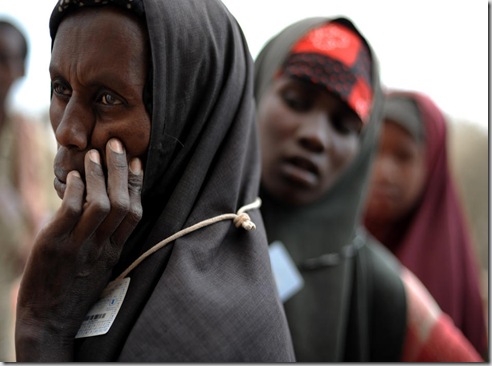 Somali refugees wait in line to recieve aid at a food distribution point at Dadaab refugee camp. ROBERTO SCHMIDT/AFP/Getty Images)

A Somali man accesses a water point at the Dadaab refugee camp on July 4, 2011. With a population of 370,000, Dadaab is the world's largest refugee camp even though it was built for just 90,000. ROBERTO SCHMIDT/AFP/Getty Images

A Somali girl being treated for severe malnutrition pushes away a cup as a woman tries to feed her at a hospital operated by the International Rescue Commission. (AP Photo/Rebecca Blackwell)

A Somali refugee waits to receive a food ration for her and her family at a food distribution point. ROBERTO SCHMIDT/AFP/Getty Images

Somali refugees sit in the yard of their makeshift shelter, fenced in with thorny branches, in Iffou 2, an area earmarked for refugee camp expansion, but yet to be approved by the Kenyan government, outside Dadaab, Kenya, Monday, July 11, 2011. U.N. refugee chief Antonio Guterres said Sunday that drought-ridden Somalia is the "worst humanitarian disaster" in the world, after meeting with refugees who endured unspeakable hardship to reach the world's largest refugee camp in Dadaab, Kenya. (AP Photo/Rebecca Blackwell)

A Somali woman walks past the frame for a sparsely-covered makeshift shelter in Iffou 2, an area earmarked for refugee camp expansion. (AP Photo/Rebecca Blackwell)
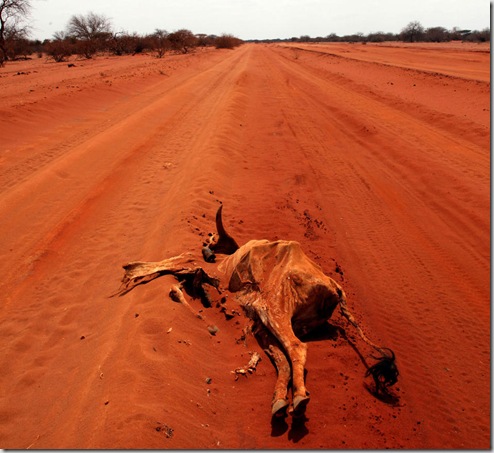 A carcass of an animal lies on an empty road, near Lagbogal, 56 kilometers from Wajir town, Wednesday, July 6, 2011. The worst drought in the Horn of Africa has sparked a severe food crisis and high malnutrition rates, with parts of Kenya and Somalia experiencing pre-famine conditions, the United Nations has said. More than 10 million people are now affected in drought-stricken areas of Djibouti, Ethiopia, Kenya, Somalia and Uganda and the situation is deteriorating, (AP Photo/ Sayyid Azim)
 Sixty-year-old Suban Osman sits with two of her malnourished grand children at a clinic run by Doctors Without Borders (MSF) at the Dadaab refugee camp on July 4, 2011. ROBERTO SCHMIDT/AFP/Getty Images
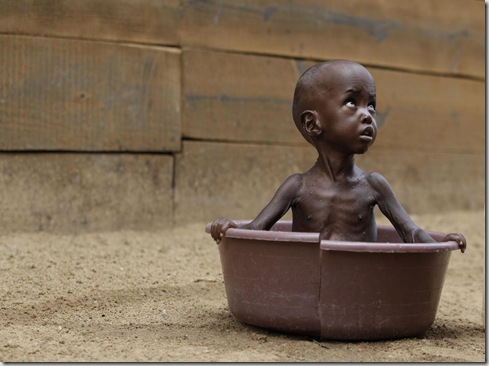
Two-year-old, Aden Salaad, looks up toward his mother, unseen, as she bathes him in a tub at a Doctors Without Borders hospital, where Aden is receiving treatment for malnutrition, in Dagahaley Camp, outside Dadaab, Kenya. (AP Photo/Rebecca Blackwell)

A Somali boy uses a wheelbarrow to carry two jerry cans filled with water to a tent that he and his family call home at the worlds biggest refugee camp. ROBERTO SCHMIDT/AFP/Getty Images

Two-year-old Shiniyo looks while bundled in her mothers arms while they stay at a clinic run by Doctors Without Borders. ROBERTO SCHMIDT/AFP/Getty Images
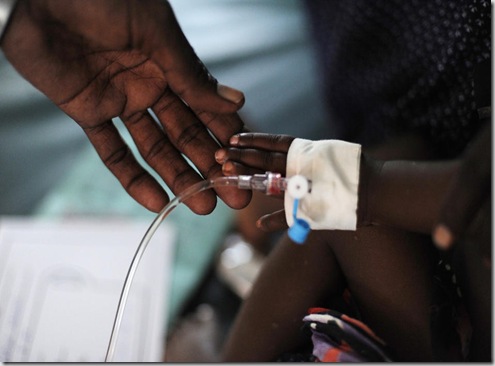
A Kenyan doctor looks at the IV drip on a child suffering from severe malnutrition at a clinic run by Medecins Sans Frontieres (MSF) at the Dadaab refugee camp on July 4, 2011. With a population of 370,000, Dadaab is the world's largest refugee camp even though it was built for just 90,000. According to Doctors Without Borders, the number of people seeking refugee keeps swelling and Dadaab will house 450,000 refugees by the end of the year, or twice the population of Geneva. With serious drought in the Horn of Africa, thousands of Somalis have arrived in recent weeks in search of food and water. ROBERTO SCHMIDT/AFP/Getty Images

Children walk down a dusty street in Dadaab refugee camp on July 4, 2011. Fatimah who fled violence in Somalia with her family one year ago says that she does not venture outside the camp to look for firewood because it is too dangerous. With a population of 370,000, Dadaab is the world's largest refugee camp even though it was built for just 90,000. With serious drought in the Horn of Africa, thousands of Somalis have arrived in recent weeks in search of food and water. ROBERTO SCHMIDT/AFP/Getty Images
Fonte
Nonostante la situazione critica secondo le stime Unicef ogni settimana arrivano 10 mila profughi tra la Somalia e il Kenya dove la malnutrizione raggiunge anche il 40%, nella speranza di trovare una situazione migliore. Il Fondo delle Nazioni Unite fa sapere alle comunità internazionali che servono 31,9 milioni di dollari per arginare la situazione e nutrire le donne e le piccole vite in pericolo, almeno per i prossimi tre mesi.
“E’ davvero umiliante trovarsi qui, la gente ha attraversato tante difficoltà per arrivare e si trova in pessime condizioni”, ha commentato il direttore Unicef per l’Africa orientale e meridionale, Elhadj As Sy, durante una visita a Dadaab, al confine tra Kenya e Somalia.
E’ stato lanciato più volte lo stato d’allerta da parte della FAO e sono stati creati diversi programmi per affrontare le emergenze, sono stati creati dei corsi per insegnare a contadini e pastori ad adattarsi e affrontare il costante ed estremo cambiamento climatico sempre più frequente, soprattutto nella previsione che la siccità durerà sino al prossimo novembre.
Fonte
http://www3.lastampa.it/esteri/sezioni/articolo/lstp/411418/
Faduma Sakow Abdullahiand her five children tried to escape starvation in Somalia by journeying to a Kenyan refugee camp. Only one day before they reached their destination, her 4-year-old daughter and 5-year-old son died of exhaustion and hunger. At first the 29-year-old widow thought the two were merely sleeping when they wouldn’t get up after a brief rest. She had to leave their bodies under a tree, unburied, so she could push on with her baby, 2-year-old and 3-year-old. She saw more than 20 other children dead or unconscious abandoned on the roadside. Eventually a passing car rescued the rest of her family from what could have been death.
“I never thought I would live to see this horror,” she said, tears rolling down her cheeks as she described the 37-day trek to Dadaab, the world’s largest refugee camp.
Tens of thousands of Somalis have watched their land dry up after years without rain. Then the livestock died. Finally all the food ran out. Now they are making the perilous journey over parched earth to refugee camps in Kenya and Ethiopia, regions that also have been hit hard by drought.

Recently-arrived Somali refugees wait to fill jerry cans with water at a newly-installed tank in Iffou 2, an area earmarked for refugee camp expansion, but yet to be approved by the Kenyan government, outside Dadaab, Kenya, Monday, July 11, 2011. U.N. refugee chief Antonio Guterres said Sunday that drought-ridden Somalia is the "worst humanitarian disaster" in the world, after meeting with refugees who endured unspeakable hardship to reach the world's largest refugee camp in Dadaab, Kenya. (AP Photo/Rebecca Blackwell)

Members of the family of Rage Mohamed are overtaken by wind-blown dust as they build a makeshift shelter around a thorny acacia tree, on the outskirts of Dagahaley Camp, outside Dadaab, Kenya, Sunday, July 10, 2011. It took the 15-person family five days to make the journey from their drought-stricken home in Somalia. They spent two nights sleeping in the open air under the tree prior to receiving tarps on Sunday. U.N. refugee chief Antonio Guterres said Sunday that drought-ridden Somalia is the "worst humanitarian disaster" in the world after meeting with refugees who endured unspeakable hardship to reach the world's largest refugee camp in Dadaab, Kenya. (AP Photo/Rebecca Blackwell)

 A young Somali girl who fled violence and drought in Somalia stands in line among adults outside a food distribution point in Dadaab refugee camp in northeastern Kenya on July 5, 2011. Dadaab, a complex of three settlements, is the world's largest refugee camp. Built to house 90,000 people and home to more than four times that number, it was already well over its maximum capacity before an influx of 30,000 refugees in the month of June. Upon arrival, the refugees find themselves tackling a chaotic system that sees new arrivals go days, even weeks, without food aid. "It still takes too much time for refugees to get proper assistance," Antoine Froidevaux, MSF's field coordinator in Dadaab told AFP. "The answer in terms of humanitarian aid is not satisfactory at all at the moment." ROBERTO SCHMIDT/AFP/Getty Images
A Somali woman waiting amongst scores of other refugees, all hoping to receive their ration cards despite a processing backlog, pleads with an organizer in Dagahaley Camp, outside Dadaab, Kenya, Monday, July 11, 2011. U.N. refugee chief Antonio Guterres said Sunday that drought-ridden Somalia is the "worst humanitarian disaster" in the world, after meeting with refugees who endured unspeakable hardship to reach the world's largest refugee camp in Dadaab, Kenya. (AP Photo/Rebecca Blackwell)

A Somali man who fled violence and drought in Somalia with his family sits on the ground outside a food distribution point in the Dadaab refugee camp. ROBERTO SCHMIDT/AFP/Getty Images

 One-year-old, Habibo Bashir, rests on a bed at a Doctors Without Borders hospital where he is being treated for severe malnutrition, in Dagahaley Camp, outside Dadaab, Kenya, Monday, July 11, 2011. U.N. refugee chief Antonio Guterres said Sunday that drought-ridden Somalia is the "worst humanitarian disaster" in the world, after meeting with refugees who endured unspeakable hardship to reach the world's largest refugee camp in Dadaab, Kenya. (AP Photo/Rebecca Blackwell)
A refugee holds her child in her arms as she and others like her mass outside a food distribution point in Dadaab in the hope of getting access to much needed aid at the worlds biggest refugee camp in the world on July 4, 2011. With a population of 370,000, Dadaab is the world's largest refugee camp even though it was built for just 90,000. With serious drought in the Horn of Africa, thousands of Somalis have arrived in recent weeks in search of food and water. AFP PHOTO/Roberto SCHMIDT

A Somali refugee drags a sack with food aid given to her at a food distribution point at the Dadaab refugee camp. ROBERTO SCHMIDT/AFP/Getty Images

Refugees newly arrived from Somalia line up to receive food rations at a receiving center in Dagahaley Camp, outside Dadaab, Kenya. The United Nations High Commissioner for Refugees estimates 1300 new refugees fleeing drought and hunger in Somalia are arriving daily in the Dadaab area. (AP Photo/Rebecca Blackwell)

 Somali refugees wait in line to recieve aid at a food distribution point at Dadaab refugee camp. ROBERTO SCHMIDT/AFP/Getty Images)
A Somali man accesses a water point at the Dadaab refugee camp on July 4, 2011. With a population of 370,000, Dadaab is the world's largest refugee camp even though it was built for just 90,000. ROBERTO SCHMIDT/AFP/Getty Images

A Somali girl being treated for severe malnutrition pushes away a cup as a woman tries to feed her at a hospital operated by the International Rescue Commission. (AP Photo/Rebecca Blackwell)

A Somali refugee waits to receive a food ration for her and her family at a food distribution point. ROBERTO SCHMIDT/AFP/Getty Images

Somali refugees sit in the yard of their makeshift shelter, fenced in with thorny branches, in Iffou 2, an area earmarked for refugee camp expansion, but yet to be approved by the Kenyan government, outside Dadaab, Kenya, Monday, July 11, 2011. U.N. refugee chief Antonio Guterres said Sunday that drought-ridden Somalia is the "worst humanitarian disaster" in the world, after meeting with refugees who endured unspeakable hardship to reach the world's largest refugee camp in Dadaab, Kenya. (AP Photo/Rebecca Blackwell)

A Somali woman walks past the frame for a sparsely-covered makeshift shelter in Iffou 2, an area earmarked for refugee camp expansion. (AP Photo/Rebecca Blackwell)

 A carcass of an animal lies on an empty road, near Lagbogal, 56 kilometers from Wajir town, Wednesday, July 6, 2011. The worst drought in the Horn of Africa has sparked a severe food crisis and high malnutrition rates, with parts of Kenya and Somalia experiencing pre-famine conditions, the United Nations has said. More than 10 million people are now affected in drought-stricken areas of Djibouti, Ethiopia, Kenya, Somalia and Uganda and the situation is deteriorating, (AP Photo/ Sayyid Azim)
 Sixty-year-old Suban Osman sits with two of her malnourished grand children at a clinic run by Doctors Without Borders (MSF) at the Dadaab refugee camp on July 4, 2011. ROBERTO SCHMIDT/AFP/Getty Images
Two-year-old, Aden Salaad, looks up toward his mother, unseen, as she bathes him in a tub at a Doctors Without Borders hospital, where Aden is receiving treatment for malnutrition, in Dagahaley Camp, outside Dadaab, Kenya. (AP Photo/Rebecca Blackwell)

A Somali boy uses a wheelbarrow to carry two jerry cans filled with water to a tent that he and his family call home at the worlds biggest refugee camp. ROBERTO SCHMIDT/AFP/Getty Images

Two-year-old Shiniyo looks while bundled in her mothers arms while they stay at a clinic run by Doctors Without Borders. ROBERTO SCHMIDT/AFP/Getty Images

A Kenyan doctor looks at the IV drip on a child suffering from severe malnutrition at a clinic run by Medecins Sans Frontieres (MSF) at the Dadaab refugee camp on July 4, 2011. With a population of 370,000, Dadaab is the world's largest refugee camp even though it was built for just 90,000. According to Doctors Without Borders, the number of people seeking refugee keeps swelling and Dadaab will house 450,000 refugees by the end of the year, or twice the population of Geneva. With serious drought in the Horn of Africa, thousands of Somalis have arrived in recent weeks in search of food and water. ROBERTO SCHMIDT/AFP/Getty Images

Children walk down a dusty street in Dadaab refugee camp on July 4, 2011. Fatimah who fled violence in Somalia with her family one year ago says that she does not venture outside the camp to look for firewood because it is too dangerous. With a population of 370,000, Dadaab is the world's largest refugee camp even though it was built for just 90,000. With serious drought in the Horn of Africa, thousands of Somalis have arrived in recent weeks in search of food and water. ROBERTO SCHMIDT/AFP/Getty Images
Fonte
Corno d’Africa, Unicef: “Due milioni di bambini malnutriti”
Dì continuo si sente parlare di crisi, di mancanza di lavoro, di difficoltà nel coprire le spese del mese, ma basta pensare che in alcune parti del mondo la situazione sia nettamente peggiore per accorgerci di quanto siamo fortunati. Secondo gli ultimi dati Unicef, nel Corno d’Africa sono oltre 2 milioni i bambini malnutriti e a rischio di sopravvivenza. Ad aggravare la situazione di queste popolazioni, che vivono nell’estrema povertà, è la forte siccità che sta colpendo il paese, una delle peggiori dell’ultimo secolo.La mancanza di piogge compromette i raccolti, gli animali muoiono e molti bambini lasciano le scuole per aiutare la famiglia a trovare del cibo. Molto spesso non si riesce a coprire nemmeno un pasto al giorno. Le zone più colpite dall’aridità sono Kenya, Somalia, Etiopia e Gibuti, e le persone in pericolo di vita sono oltre 10 milioni, tra i quali 2 milioni di bambini al di sotto dei 5 anni di cui 500mila in pericolo di morte o di avere gravi forme di malformazioni fisiche e mentali.Nonostante la situazione critica secondo le stime Unicef ogni settimana arrivano 10 mila profughi tra la Somalia e il Kenya dove la malnutrizione raggiunge anche il 40%, nella speranza di trovare una situazione migliore. Il Fondo delle Nazioni Unite fa sapere alle comunità internazionali che servono 31,9 milioni di dollari per arginare la situazione e nutrire le donne e le piccole vite in pericolo, almeno per i prossimi tre mesi.
“E’ davvero umiliante trovarsi qui, la gente ha attraversato tante difficoltà per arrivare e si trova in pessime condizioni”, ha commentato il direttore Unicef per l’Africa orientale e meridionale, Elhadj As Sy, durante una visita a Dadaab, al confine tra Kenya e Somalia.
E’ stato lanciato più volte lo stato d’allerta da parte della FAO e sono stati creati diversi programmi per affrontare le emergenze, sono stati creati dei corsi per insegnare a contadini e pastori ad adattarsi e affrontare il costante ed estremo cambiamento climatico sempre più frequente, soprattutto nella previsione che la siccità durerà sino al prossimo novembre.
Fonte
http://www3.lastampa.it/esteri/sezioni/articolo/lstp/411418/
Iscriviti a:
Post (Atom)
LinkWithin
